home: https://starling.us/gan
Copyright Ĝan Ŭesli Starling 2001-2026
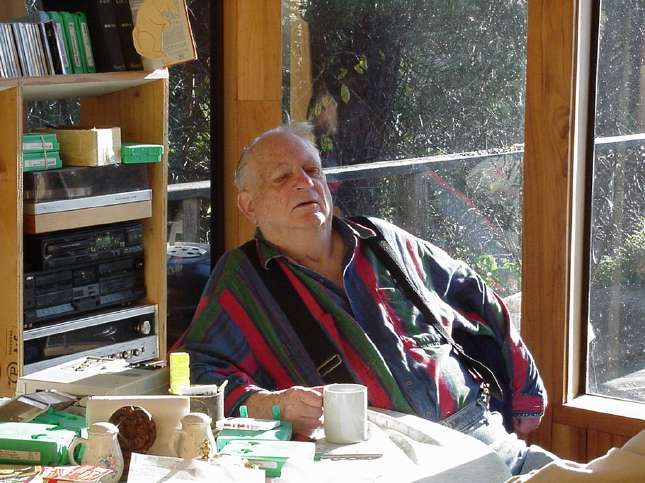
In January of the year 2000, I spend a weekend at the home of my all-time favorite author, Jack Vance.
Back in 2000, my camera was a Sony Mavica. Big and hulky it was, the storage medium a built-in CD-ROM drive. Sadly with a resolution of just only 640x480. But do click on any of the thumbnails below to at least enjoy seeing that.
|
|
Jack wrote of having written most of his stories and novels long hand in ink on paper. The first of those from a deck chair aboard merchant marine vessels during World War Two. By which time already he had been starting to go slowly blind from macular degeneration. Getting in, he’d had to cheat on the vision exam by first memorizing the standard eye chart. He wrote right up until his death in 2013.
|
|
|
|
Jack wrote science fiction, fantasy, mystery. Often all three at once inside the same story. Ignoring the very concept of genres, Jack wrote straight through and across all those boundaries. It long made him hard to classify, with book sellers not always knowing where to shelve him. It also made him untiringly popular with his very devoted fans. But not so much with publishers who didn’t know how to market his works. Editors were further annoyed by his contracting the old-fashioned way...for the printing of editions, rather than to pay him once and then own the rights forever.
|
|
|
|
|
Much of Jack’s writing can be described as timeless “ meaning that often a reader can’t tell when it was written. None of his later works will ever age. Above are pictures taken form a weekend visit I made to the house where he lived with is wife Norma, who preceded him into that great mystery beyond by many years.
The occasion depicted above was a working weekend for a project called the Vance Integral Edition in which I played a minor role. Minor indeed, but still enough of one merit being invited along on that epic weekend. A visit forever to be remembered.
The VIE was a project thought up by Paul Rhodes, an artist and one of Jack’s most ardent fans: Wiki . He and together with some 300 others, myself included, all slaved away together to republish all of Jack’s works in a 44-volume collector’s edition.
On this occasion the leadership (plus two others) were gathered together with Jack to study original manuscripts so as to insure complete integrity of the new edition with such of his original manuscripts as still were in existence. Far too many of the stories, had got sorely distorted over the years (tarted up according to Jack) by hack editors employed at the publishing houses. While said leadership debated matters above my pay grade of zero dollars per hour, I was chiefly occupied with the continuance of proofreading scans done by others.
I was one of the plus two in this hallowed convocation. My my own contribution to the effort up to that point had been OCR scanning: five entire novels and quite a few short stories. Initial scanning plus proofing the scan. Mostly from out of my own collection: which at the time included many hardcover first editions, most of those signed. These hunted down from catalogs of rare book sellers. Certain others were pulp softcovers read so many times as to merit a description of loose leaf editions. Also a handful of pulp magazines.
In order to perform my initial labors I’d first had to purchase a high quality HP scanner and professional grade image-to-text translating program. Both quite expensive. Then followed countless hours of positioning an open book exactly straight on to the scanner, page after page, pressing the scan button for each, processing that image into text, proofreading same. Not I alone was doing that. There were a good many others. But of them all, I had contributed the largest bulk of scanned text. Which is what won me an invitation to be among the plus-two present.
How I came to be invited onto the team in the first place stems from another project of mine. A language whose name is not known to many, but surely will be to any fan of classic science fiction: Esperanto.
Which is exactly how I myself first came to know of the language. Not often, but occasionally, I had come upon the name, discounting it as something just only made up. Such as, for instance, Terra Lingua, among several others. Just only something which authors might use to add futuristic nuance to their stories. In the Stainless Steel Rat series by Jack’s very close friend, Harry Harrison, however, characters were quoted to speak whole lines of text in Esperanto. Sentences in a foreign language from which the basic sense still was quite clear to someone knowing just only English.
Silly me, through all of six novels I had mistook those examples of dialog to have been crafted by the author himself. And far more cleverly so than any prior author before him. Because in each case, I could quite easily pick out the gist. Then in an afterword to book six, Harrison explained to his readers that Esperanto wasn’t made up. Not his own creation at all. Instead it was an actual, real world language. He included an address to write to for anyone interested in learning more.
Being myself a failed polyglot (having studied but got not far at all in both German and Japanese) here at last was my chance to overcome my stumbling block toward full bilingualism. Never why anyone would choose to describe as a patriotic nationalist, always I had wished to consider myself instead a citizen of the whole world. Of the galaxy, even. And succeed I did, cruising easily through a free, ten-lesson correspondence course offered by the Esperanto League for North America. And after that another, much longer one, complete with cassette tapes, offered by the Sennacia Asocio Tutmonda (Worldwide Nationless Association). Then afterward, just on my own. Mostly by reading aloud to myself. An epic in three volumes, some 900-plus pages, titled La Faraono. This being a translation into Esperanto from out of Polish. Authored by Bolesław Prus, in English the title would be The Pharaoh: Wiki
Anyhow, I got to the point where I was wanting to contribute something worthwhile to the Esperanto movement. And for that effort, I decided I would translate a few very well loved short stories from out of English. The first of which would be Three-legged Joe by Jack Vance. Which, I was certain, young people would easily relate to and also find very amusing indeed.
But first I must obtain the author’s permission. I wrote to Jack care of the publisher. And before long got a letter back from Norma, which I still have. From which I learned to my astonishment that Jack was blind. Had been so for decades. She couldn’t grant me official permission to do my translation, but insofar as Esperanto was not a market for which they had a commercial publishing interest it would be unofficially okay. Happily, I went ahead.
In the process of that effort, I developed further ambitions. In the meanwhile I’d also picked up some more information about Jack himself. His many trials and tribulations in having to deal with various publishers. The fact that never anymore does he outright sell any rights to his works. This for having (like many of his SF contemporaries) been thoroughly ripped off in the process.
Having thoroughly mulled all this prior history over, I took myself to the Kalamazoo Public Library’s reference desk asking to peruse a White Pages telephone directory for Oakland California. This was circa 1997, you have to understand. And so, no Internet yet. But even so, we still had effective ways and means to gain information. So, there he was, listed just like a normal person, telephone number and all.
Once home, I picked up the phone and dialed the number. Push-button, not rotary dial; we weren’t barbarians anymore, after all. At best, I had expected for Norma to answer. Or possibly a cassette tape answering machine. But instead, Jack himself picked up the phone. I made my pitch, and we cut a deal. Jack would accept a check from me for $500 in exchange for publishing rights in Esperanto. Of course, it turned out not quite so easy as that. I sent the check, and Jack got in contact with his lawyer. Who then wrote up a contract. Not carte blanche, but with certain limits. Five novels and twenty short stories of my own choosing. Plenty enough to keep me going for a number of years.
My first publication was of Trigamba Joĉjo. This as a pamphlet with illustrations by a local artist, then a student at WMU. A beautiful effort which sold only just a few copies. This after paying for a print run of fifteen hundred. The bulk of which I still have in boxes down in the basement.
The main obstacle to sales was my having conjoined two separate Esperanto related ambitions into one. A co-linguist friend, Phillip Driscoll (whose own alternative hobby besides Esperanto was typefaces and lithograph printing) had interested me in something called Shavian script: Wiki . And funds not being sufficient for me to pursue both at once in the form of printed publications for sale, I combined the two. Together with Phillip, we adapted Shaw’s alphabet (originally for English) to suit Esperanto instead.
Necessarily, this called for a number of self-evident changes. At least if we were to follow the script’s internal logic: simplest glyphs for most frequent sounds. Plus, insofar as Shavian was intended as a replacement for cursive, thus to only ever be written by hand, I myself had to create computer fonts by which to print it. And this required the purchase of a $400 commercial program from Germany.
And so I went to enormous effort for that initial publication. An introduction to Shavian script for Esperanto with my translation of Three-legged Joe as its base material. This in deliberate imitation of the original book Shavian script instructional manual in English. That one had used George Bernard Shaw’s Androclese and the Lion as its practice reading material. Printed in black and green on high quality paper, the pamphlet ran to 72 pages.
I judged the result to be very fine. I had recruited an Esperantist proofreader in Hungary so as to insure there’d be no embarrassing typos. That in ordinary Esperanto orthography, prior to re-typesetting in Shavian script. Then I tried to sell my pamphlets. I did find some buyers. These were Esperanto language booksellers in foreign countries. They sent me checks in the mail. In making out those checks, each and every one of them had failed to note the legal spelling of my name as to be found on the copyright page. So rather than John Wesley Starling, they wrote out checks to my name as shown on the cover Ĝan Ŭesli Starling. Esperanto being phonetic, my first and second birth names would have sounded like Yo-hn Vesle?. Hardly euphonious.
Bit of a problem with trying to cash those checks. Nor did their total come anywhere close to balancing my expenses. And, as already mentioned. I still have an entire banker’s box of unsold copies. Would you like a few? I’ll send you as many as you might like at no cost whatever beyond just only the postage. Time to time I send out an unsolicited package of ten at my own expense to randomly chosen Esperanto clubs overseas.
I mentioned receiving checks, yes? In order to cash them I petitioned the District Court in Kalamazoo for a legal change to my name’s orthography. Not just only for that, but a two further reasons as well. Firstly, since age fifteen, I been Buddhist. Which made for social inconvenience everyone making assumptions based upon my being named after my paternal grandfather, who himself had been named after the founder of the Methodist Church. And further, seven years earlier my first wife and I had named our son Skajler Ananda Starling, said first name sounding in English like Sky’-ler, and a Buddhist middle name (which sound is the same in both English and Esperanto). Having inflicted that on him, hardly could I hold back from doing likewise to myself.
And so now you know why my name looks foreign even though I was born and raised in Kalamazoo Michigan. My son, by the way, quite likes the name that we gave him. His mom chose the first, and I the second. When hearing it called out in a crowd, he knows it’s him that someone is calling. His mom picked the first name after a friend she’d known in grade school, who’d gone by a shortened version of just only Sky. Which she had hoped all his friends would likewise shorten. Wanting to know its meaning and origin, I looked it up. Turned out the origin was Dutch, and that the proper spelling was Schuyler. Therefor did I persuade her that we spell it in Esperanto, which would hardly be any less pronounceable on sight alone. Anyhow, that’s the story on both our names.
At one point I packaged up a box of 100 copies, donating these gratis to the bookstore of the Esperanto League for North America in El Cerrito CA. At this particular time there was a rather irascible fellow from (unless I’m mistaken) Romania. Upon receipt, he not so much as even opened the package. Instead he refused receipt of it from the postman. And so it got returned to me with postage due.
Provoked to a fit of irascibility myself, immediately I resigned membership from ELNA. Not merely on this single account alone, but for it plus also a prior annoyance. That one not at all to do with the central office guy, but instead the board as a whole. Other ordinary members had likewise withdrawn for their own reasons. And after not to many years ELNA itself was no more. Not to leave a total vacuum, replaced instead by separate Esperanto movements: one for the US, another for Canada.
Some months later, my little pamphlet suffered a thorough lambasting across five full pages of an Esperanto publication named Monato from out of Belgium. A certain Simon Payne absolutely hated our adaptation of Shavian script. Rather than follow the original author’s stated logic (simplest glyphs for most frequent sounds), Payne preferred that we had left things just as they were, instead adding new characters.
Or so was his claim. Which he went on and on about, going even so far as to offer personal insult to me individually. But as I later learned to be the real cause of Payne’s annoyance, he had himself been working on a similar project to adapt Shavian to Esperanto. This with neither of us knowing about the other’s effort. And I had beat him to publication.
In revenge over this very ill treatment in world wide print, I determined that Payne’s own effort should never gain traction. How I did this was by swamping the market. I packaged up a dozen or so envelopes, ten copies apiece of my own pamphlet, and mailed them off free to each of the more prominent Esperanto distributors. Which must have worked, since never have I seen a competing edition.
As the original commercial effort had fallen completely flat, I had some rethinking to do. Really, what was my purpose? Reduced to its essence, I had only been wanting to just enjoy doing the translations themselves. Then, when finished, somehow present them to the Esperanto community. And so, I purchased an Internet domain: esperanto.us . Which at first presented just only a few short stories, these as web pages hand coded in HTML.
Some years later, various new formats for e-books began to come out: mobi, kindle, epub. Whereupon I afterward published instead according to those. All as free downloads without any tracking. Which is how the setup remains to day. Translations mostly from Jack Vance. Also a few from such luminaries as Clifford D Simak and Clark Ashton Smith. All with paid permission according to official contracts. What better hobby for my retirement? In addition to ham radio, that is.